Financial Management
The Hidden Cost of Budget vs Actuals Delays in Real Estate Development
Real estate projects lose 5-10% of margins—€2.5-5M per €50M project—to delayed budget visibility alone. Excel-based tracking creates 3-4 week detection lags that eliminate intervention options. Real-time platforms compress detection-to-action timelines, protecting margins through early variance identification. Includes project, portfolio, and fund-level impact analysis with ROI calculations.
Real estate development projects lose 5-10% of total margins to delayed cost visibility—not from budget overruns themselves, though that happens often enough, but from discovering those overruns weeks too late to intervene. For a €50 million project, that represents €2.5-5 million in preventable losses that occur before teams even detect the deviation. Research from Bain & Company reveals the math: The delay between when costs deviate and when teams detect the deviation costs more than the deviation itself. By the time finance teams close the books and compare budget to actuals, contingencies are burned and corrective action windows have closed.
Defining budget-to-actuals lag The time period between when project costs deviate from budget and when that deviation is detected and reported. In traditional Excel-based workflows, this lag ranges from 2-8 weeks. In real-time cost platforms, the lag compresses to 1-3 days. The lag duration directly determines available intervention options and ultimate margin impact.
Quantifying the Industry-Wide Problem
Construction projects exceed budgets regularly. More revealing: The Urban Land Institute’s 2023 study shows that even modest 10% budget overruns balloon to 20% when delays and opportunity costs are factored in.
For a €50 million development project, that’s €10 million in preventable expenses.
Key Finding: Organisations using real-time budget tracking detect cost variances 3-4 weeks earlier than Excel-based workflows, creating intervention windows that protect 5-10% of project margins. The time compression between deviation and detection matters more than the deviation amount itself.
The Cost at Project Manager Level: Outdated Data, Multiplied Errors
Project-level budget tracking delays range from 5-21 days in Excel-based workflows, creating three compounding cost drivers that multiply detection errors before portfolio-level visibility occurs.
“If you’re working with Excel versus Excel, you’re working on last week’s problem,” a senior project manager at a European development firm explains. “The day before you check the data, it’s already outdated.”
Three cost drivers compound at the project level:
Cost Driver 1: Time Lag Between Spending and Detection
Typical excel-based timeline goes like this:
- Days 1-7: Costs incurred, invoices submitted
- Days 8-14: Manual ERP export and Excel reconciliation
- Days 15-21: Budget variance identified and reported
- Day 22+: Mitigation options explored (often too late)
Most enterprise environments source actual costs from ERP or financial accounting systems. Project controllers manually export this data and compare it against Excel-based budgets. The process takes days or weeks—a delay that transforms manageable variances into locked-in overruns.
Anca Stefanescu, VP Europe at Alasco, describes the consequence: “Most finance teams operate on a monthly or quarterly rhythm. When you close the books after month-end, you realise you’re 15 or 20% over budget on HVAC, but by that point, you’ve burned through your contingency already.”
A €20,000 variance discovered in week one offers options: renegotiate with contractors, adjust specifications, reallocate from other budget lines. The same variance discovered in week eight is irreversible — the work is complete, the invoice approved, and the contingency already depleted.
Cost Driver 2: Version Control Creates Duplicate Truth
We have an Excel proliferation problem:
- Average project generates 8-15 budget file versions
- No single source of truth across project stakeholders
- Manual reconciliation required before any decision
Files named “Project_cost_V3_FINAL_Final.xls” signal a deeper problem: Nobody knows which spreadsheet holds current numbers. Project managers described their reality: “I don’t trust any Excel sheet where I didn’t create it myself. Only mine is accurate. All the others are wrong.”
When multiple versions circulate, teams waste hours reconciling discrepancies instead of solving problems. In small teams, verbal confirmation bridges the gap. At portfolio scale, version chaos makes reliable cost tracking impossible.
Hidden Time Cost: Project managers spend 3-6 hours weekly verifying which budget version is current and reconciling discrepancies between versions—time that could be spent on variance mitigation.
Cost Driver 3: Manual Reconciliation Doesn’t Scale
The typical manual verification process goes like this:
- Download banking statements (30-60 minutes)
- Print and manually highlight paid vs. budgeted items (2-3 hours)
- Investigate deviations above €10,000 threshold (3-5 hours per variance)
- Smaller variances ignored due to capacity constraints
One portfolio manager described their actuals verification process: Every week she downloads the banking statements, prints them out, manually highlights what was paid versus what should have been paid, updates her project budget sheet in Excel, and then investigates deviations above €10,000.
Smaller variances get ignored—not because they don’t matter, but because manual verification has capacity limits. Those small, uninvestigated variances accumulate into significant margin erosion.
Capacity Constraint Impact: When verification capacity limits investigation to variances above €10,000, a project with twenty €5,000 uninvestigated variances loses €100,000 in margin erosion that never triggers formal review.
The Portfolio Penalty: Multi-Project Visibility Failures
Excel-based tracking that adds 6-12 hours of weekly overhead per project multiplies to 60-120 hours monthly across a 10-project portfolio—the equivalent of 1.5-3 full-time employees doing data normalization instead of portfolio management.
When managing multiple concurrent projects, Excel’s limitations compound exponentially. The head of development needs consolidated budget-to-actuals visibility across the entire portfolio, but instead coordinates between disconnected, project-specific spreadsheets.
The portfolio-scale cost drivers:
Portfolio Cost Driver 1: Data Normalization Absorbs Hours Weekly
What we typically see in projects goes like this:
- Cost category alignment: Each project uses different line item structures which makes multi-project comparisons almost impossible.
- Budget methodology differences: Top-down vs. bottom-up, different contingency treatments
- Time required: 8-15 hours weekly for 10-project portfolio normalization
Each project manager structures their Excel sheets differently. Cost categories don’t align. Update frequencies vary. Budget methodologies differ. Before the head of development or financial controller can even analyze portfolio performance, they spend hours normalizing data formats.
One development head explained: “There’s the project controller responsible for data in the financial accounting system, and the project manager keeping the budget in Excel. They try to compare numbers and keep them on the same level. This is followed by sometimes deep dives into why one number is twice as big as the other.”
Those “deep dives” represent sunk time that could have been spent on corrective action if the variance had surfaced earlier.
Opportunity Cost: 15 hours of weekly normalization across a portfolio equals 780 hours annually—the equivalent of a half-time senior analyst position spent on data cleanup instead of strategic analysis.
Portfolio Cost Driver 2: Pattern Recognition Failure Multiplies Risk
All these cost drivers, multiply and amplify at the portfolio level:
- Excel-based tracking: Patterns visible only at quarterly portfolio reviews (90-day lag)
- Risk multiplication: Pattern detected across 5 projects in month 1 vs. month 4
With delayed comparisons - you can never know if the HVAC cost spike on Project A an isolated issue, or a market trend affecting your entire pipeline. Excel makes cross-project pattern analysis nearly impossible until quarterly reviews—by which point multiple projects have committed to overpriced contracts.
Early pattern detection enables portfolio-wide mitigation: bulk negotiations with suppliers, specification adjustments across projects, or strategic decisions to pause certain developments. Late detection means each project independently absorbs the full impact.
Portfolio Cost Driver 3: Capital Allocation Operates on Stale Data
Without real-time budget vs actual comparisons, you introduce a lag in decision making:
- Using Excel-based data: Capital decisions are often based on 2-4 week old data;
- Consequence: Suboptimal capital deployment, missed acceleration opportunities, contingency misallocation
Should you accelerate Project B to free up capital for Project C? Redirect engineering resources? Deploy contingency from Project A’s surplus to cover Project D’s emerging variance? These decisions require current cost data across all projects.
With Excel-based tracking operating on weekly or monthly lag, capital allocation decisions are always reactive, never proactive. Projects that could have been accelerated sit idle. Resources that should have been redeployed stay locked in place. Contingencies that could have covered emerging variances remain siloed in projects that don’t need them.
Capital Efficiency Impact: A 10-project portfolio with €50M in aggregate contingency, operating on 3-week data lag, typically has €5-8M in misallocated contingency at any given time—surplus sitting unused in some projects while others burn through inadequate reserves.
These portfolio-level delays compound further when they roll up into fund reporting and investor governance.
Fund-Level Impact: Investor Confidence and Approval Delays
Budget deviations above specific thresholds—typically €50,000 to €100,000 depending on project size and fund structure—trigger formal investor or lender approval requirements. These aren’t formalities. They represent material changes to the capital deployment plan that limited partners and financing banks must evaluate.
Late detection creates two fund-level costs:
Fund Cost Driver 1: Approval Request Timing Signals Management Capability
Imagine yourself having the following two conversations with your fund manager:
Early Detection (Real-Time Visibility): “We’ve identified a potential €75,000 overrun on mechanical systems in week 3. We have three mitigation options we’re evaluating: specification adjustment (-€50K), supplier renegotiation (-€30K), or contingency deployment. Recommend option 1, awaiting your approval to proceed.”
Late Detection (Excel-Based Workflow): “We’ve discovered a €75,000 overrun on mechanical systems that occurred over weeks 4–8. The work is complete, the invoice is approved, the contingency is depleted, and no corrective options remain. We now need retroactive approval and additional capital deployment.”
When variance detection happens in real time, the conversation with investors is proactive:
When detection happens weeks late, the conversation becomes reactive.
The first builds confidence in management capabilities. The second erodes trust.
Which one conversation would you rather have?
Fund Cost Driver 2: Investor Reporting Becomes Backward-Looking
The problem with reporting is that minor data lags compound:
- Project-level data lag: 2-4 weeks behind actual spending
- Portfolio consolidation lag: Additional 1-2 weeks for normalization
- Fund reporting preparation: 1 week for quality control and narrative
- Total lag at investor reporting: 4-7 weeks between project spending and LP visibility
Fund-level financial controllers consolidate project performance for quarterly limited partner updates. When underlying project data is weeks old or unreliable, these reports become historical snapshots rather than forward-looking management tools.
One fund manager described the cascade effect: “If project data is wrong at month-end, our fund reporting is wrong. If investors spot discrepancies between what we reported last quarter and what actuals show this quarter, we spend the entire next call explaining variances instead of discussing strategy and opportunities.”
That shift—from strategic partner to defensive explainer—directly impacts the fund’s ability to raise subsequent capital vehicles or secure favorable terms on new acquisitions.
Capital Raising Impact: Funds with consistent reporting accuracy and proactive variance management close subsequent fundraising vehicles 3-6 months faster and secure 10-25 basis points better terms on management fees and carry structures compared to funds with reactive, correction-heavy reporting patterns.
“We need to report to our board of management and they’re not asking for an Excel sheet, they ask for some nice figures and nice business intelligence just to see where we are budget-wise in the projects.” - Large European Project Controller
Why Traditional Solutions Fail: Adding Friction Without Fixing Detection
The instinct is to add more oversight: more frequent budget reviews, additional approval layers, stricter variance tolerance. These interventions add cost without addressing the root problem—the time gap between spending and visibility.
Monthly budget reviews don’t help when data is already weeks old
Increasing review frequency from quarterly to monthly feels productive. But if the data being reviewed is 2-4 weeks old, monthly reviews just mean examining stale data more frequently. The HVAC overrun happened four weeks ago. Reviewing it today doesn’t create action options that existed four weeks ago.
Additional approval layers slow decision-making without improving detection
Adding sign-off requirements—requiring two approvals instead of one, or escalating smaller variances to senior management—creates the illusion of control. But more sign-offs on change orders don’t surface unexpected costs faster. They just add friction to the approval process while the underlying detection lag remains unchanged.
Stricter variance tolerance creates reporting theater
Lowering approval thresholds from €10,000 to €5,000 seems like increased vigilance. In practice, teams learn to game the system: splitting invoices to stay under thresholds, deferring cost recognition to more favorable periods, or absorbing variances in flexible “miscellaneous” categories. The budget looks healthier on paper while underlying issues grow.
All three traditional interventions treat symptoms (late response to variances) rather than the disease (late detection of variances). The structural lag between spending and visibility remains untouched.
The Real-Time Cost Visibility Alternative
Organisations that have eliminated the budget-to-actuals lag report consistent outcomes: 50% reduction in cost reporting time, variance detection early enough for meaningful intervention, and portfolio-level pattern recognition that enables proactive management.
How real-time visibility changes the economics:
Compression of Detection-to-Action Timeline
When project controllers see budget-to-actual variance daily instead of monthly, intervention happens while options still exist. That €20,000 HVAC variance gets addressed when it’s €5,000 and the contractor can still adjust specifications on remaining units.
Elimination of Manual Reconciliation Costs
Automated sync between financial accounting systems and budget tracking eliminates the hours spent downloading statements, updating spreadsheets, and investigating discrepancies between systems. Those hours redirect to analysis and problem-solving.
Portfolio Pattern Recognition at Scale
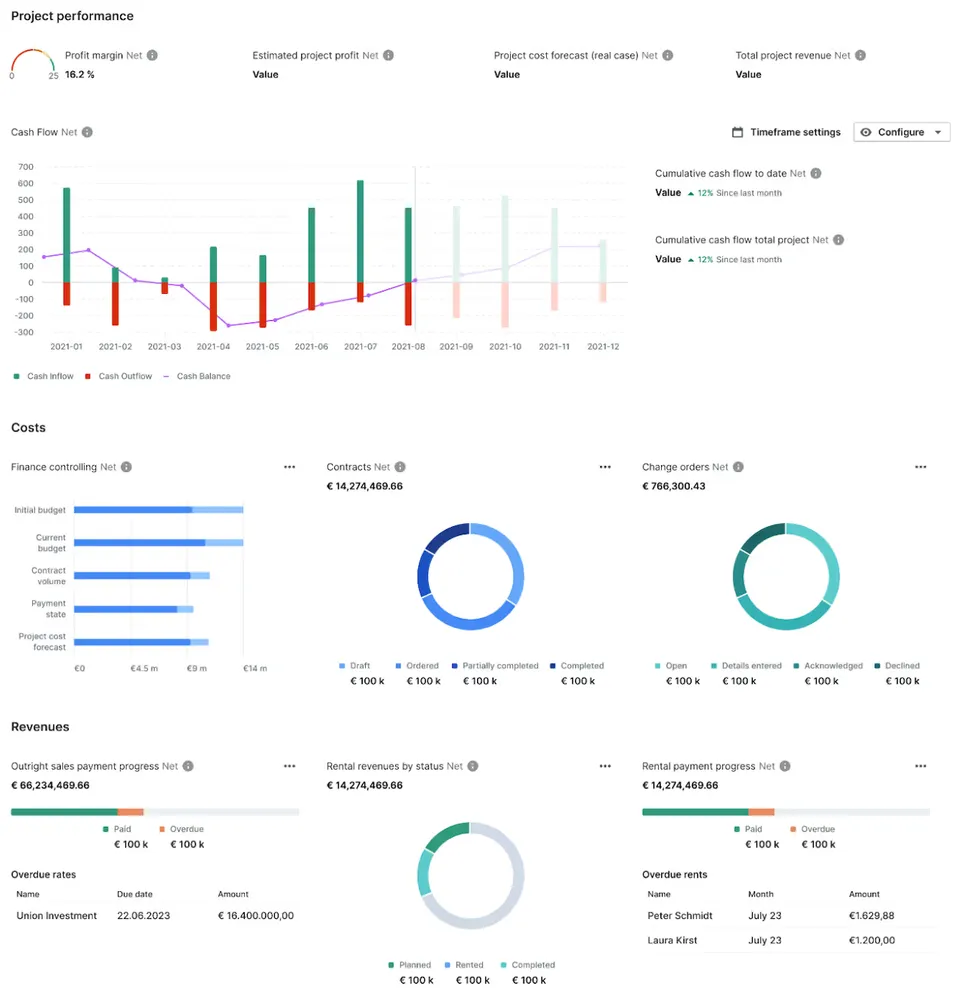
When all projects report into a unified platform with standardised cost structures, cross-project patterns surface immediately. The HVAC spike on Project A appears in portfolio dashboards the same week, triggering investigation across all active projects before contracts are signed.
Investor Conversations Shift from Reactive to Strategic
Real-time data enables fund managers to report current portfolio health with confidence. Variances are presented with context and mitigation plans, not discovered mid-call. Capital partners see proactive management rather than damage control.
From Cost Center to Competitive Advantage
Budget vs actuals tracking has traditionally been viewed as back-office administration—necessary but not strategic. That framing misses the competitive reality, which goes like this:
Real-time data ensures margin protection advantage Development firms that compress the detection-to-action timeline protect margins their competitors sacrifice. While competitors operating on monthly reporting cycles discover and address variances 4 weeks late, real-time operators intervene in week one. The margin differential: 5-10% of total project value.
Concrete Example: Two firms bidding on similar €50M projects with 12% target margins. Firm A (Excel-based) delivers 7% actual margin after late-detected overruns erode 5 percentage points. Firm B (real-time visibility) delivers 11% actual margin through early intervention. On equivalent projects, Firm B generates €2M more profit—capital that compounds across portfolio expansion and fund returns.
Capital Partner Advantage Fund managers who report current, reliable portfolio health attract capital on better terms. Limited partners choosing between two fund managers with equivalent track records favor the manager demonstrating proactive cost control and accurate reporting. The advantage manifests in faster fundraising timelines, better management fees and lower investor oversight requirements (reduced reporting burden).
Supplier Negotiation Advantage Project teams that spot variance patterns early negotiate supplier contracts their peers can’t match. Detecting portfolio-wide material cost inflation in week 2 instead of month 3 enables:
- Bulk renegotiation across multiple projects
- Strategic contract postponement during price spikes
- Supplier substitution before contract lock-in
Strategic Decision Advantage Real-time portfolio visibility enables capital allocation decisions competitors can’t make. Should you accelerate Project B’s timeline to capitalise on market conditions? Redirect engineering resources from Project C to D? Deploy Project A’s contingency surplus to cover emerging Project E variance? These decisions require current data.
Excel-based portfolios make capital decisions on 3-4 week old data—by which point market windows have closed, resource conflicts have escalated, and contingency opportunities have passed.
As one project controller summarised: “When the whole team enters current knowledge around contracts and change orders and keeps the system alive, you track changes much faster and at a much higher level of accuracy compared to outdated Excel sheets. You’re able to plan counter-measures against a change order or create a budget shift way earlier than if you don’t have real-time data.”
| Problem | Traditional approach (Excel) | Real Time Budget vs Actuals |
| HVAC variance detected 8 weeks late | Monthly budget reviews with week-old data | Daily variance alerts enable specs adjustments |
| Portfolio patterns invisible until quarterly review | Project-by-project Excel tracking and normalization | Unified platform surfaces cross-project trends immediately |
| Investor approval discussions get tense | Retroactive reporting of cost overruns | Proactive variance flagging with mitigation options. |
In a market defined by tighter margins, rising construction volatility, and increasing investor scrutiny, real-time cost visibility is no longer an efficiency upgrade — it is a competitive moat. The firms that eliminate detection lag consistently outperform those that don’t, not by chance but through operational discipline. The economics are clear: faster detection equals stronger margins, better capital allocation, and materially higher investor confidence.
Primary Research Sources:
Urban Land Institute (2023)
Cost overruns in real estate development: The domino effect of budget miscalculations****
Energy Infrastructure Research (2025)
Beyond economies of scale: Learning from construction cost overrun risks and time delays in global energy infrastructure projects - Published in: Energy Research & Social Science, Volume 123, May 2025****
Infrastructure Cost Overruns Study (2025)
Cost overruns of infrastructure projects – distributions, causes and remedies - Published in: Transportation Research Part A, Volume 198, August 2025